





Introspective Research to Understand Inner Processes
How can we do introspective research to better understand what we are doing and where we are going? Where can we find information?

Welcome to our exploration of introspective research! In a world bustling with external stimuli and constant distractions, taking a moment to look inward can be incredibly valuable. This blog post will guide you through what introspective research is, why it’s important, and how it can enrich our understanding of ourselves and others. Whether you’re curious about personal growth or seeking new insights into human behavior, you’ll find something here to inspire your journey. So, let’s dive in and discover the transformative power of looking within!
Trying to improve life is the goal of every page of this site. We will use art, psychology, and economics to analyze introspection. This will make it more useful.
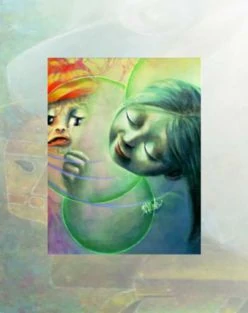
Painter/writer Aurora Mazzoldi applies the results of her research to introspective painting.
Introspective psychologist Antonella Giannini applies them to psychology.
The inner explorer can then benefit from the experience of a psychologist and the help of introspective paintings.
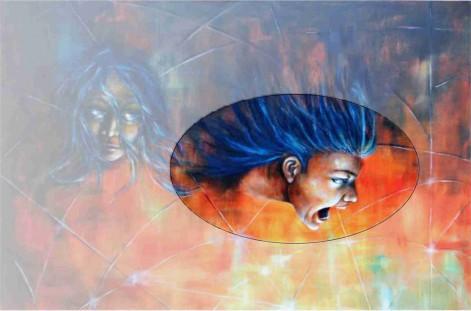
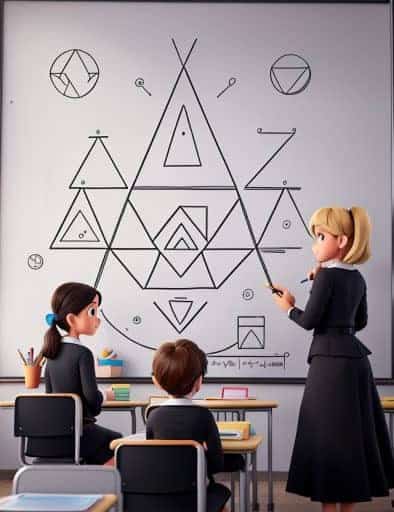
They show the world within us instead of the outer world. They make it easier to understand inner processes. When we were in school, did we need blackboard explanations? Well, introspective canvases are a bit like the drawings of geometric figures on the blackboard, which made it clearer for us to explain math.
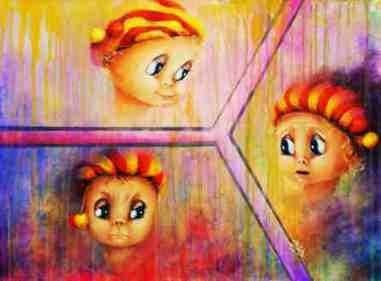
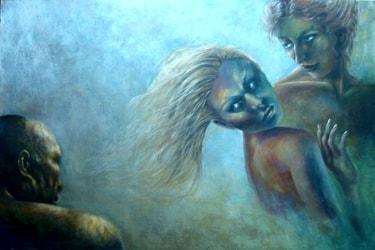
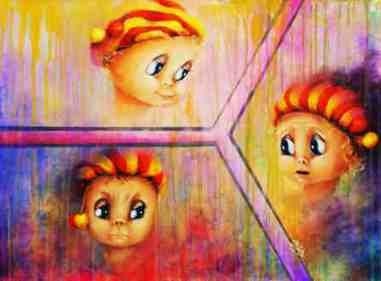
For example, the side painting shows how certain human relationships can be only apparent. The figure at the top tries to communicate, but the one on the right is afraid and the one below closes to any form of emotional exchange. The different intensities of colors help to enter the situation. This is important. It is necessary to enter the representation and not limit oneself to a superficial view.
The viewer can enter the painting and try to understand its message, either alone or with the help of a therapist. Therapists can then appreciate the catalytic function of introspective canvases. Indeed, they help to bring out emotions. Thus, they can use them both in individual sessions and in groups.
Introspective Exploration Is Open to All
Many inner explorers, past and present, have contributed to our inner research.
They have shown many aspects of reality — either in writing or in words — and made it easier to come to conclusions. Some of these conclusions can be found in these pages.
Conclusions are never final, but they help us to move forward. We base our conclusions on our intuitions, and those of other people. Everything is constantly evolving. So, you will not find any gurus here. There are no doctrines or established teachings on this site. We show some results we have achieved.
Pages of Useful Information for the Inner Explorer
Inner research takes time and persistence. We have provided many pages (and a book). They meet the needs of people who spend time doing introspective research. Here are a few:
- Introspective Art makes inner research easier and shows how we make a mess of our lives. How? With psychological games (see also Eric Berne). And by misusing our forces and the mechanisms of our personality.
- An example of how to read a painting that represents power games in relationships. This painting represents the dynamics of a couple unconventionally.
- How to go deep into a painting. How to use it for inner exploration. And how to understand the message in its symbols. We realize then that a painting can say more than what it appears to say at first glance.
Direct Contact with Paintings
The colors of the painting arouse emotions in the viewer.
They can then go beyond the aesthetic and discover the deeper meanings of the painting. The painting can then have direct contact with the viewer.
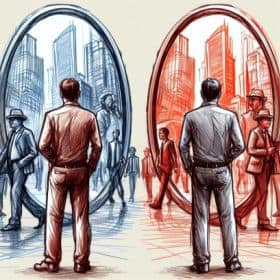
Finally, our research shows that what happens within us depends on our reactions. It also suggests that a spiral movement connects us to external reality, a spiral in which we are at the center. When we change something within ourselves, that change affects external reality.
Rarely do we realize that we could behave differently in front of reality, and we suffer. But we find it hard to change ourselves. And to stop acting mechanically.
The introspective investigation takes place within us. The ideas we offer in these pages may be useful to someone to accelerate this change. In that case, we will have done our job.
Luis Pisoni